
Understanding the way sound passes between various materials can transform your entire plan of assembly, and Inform you of your most efficient options. Having the answers around what makes Acoustic design different from Soundproofing can be a great place to start - but with all the info at your fingertips, be sure to explore!
SOUND SOLUTIONS
LEARN
SOUNDPROOFING STEP-BY-STEP
Explore wall, Ceiling, and Floor Assembly Plans to Understand the Range of Options and Materials Available Toward your Project.
LEED STANDARDS
Proud Distributor of products meeting stringent LEED standards which earn each project points Toward Full LEED Project Certification.
SOUNDPROOFING THEORY
Take a look at our content information providing detailed insight into Sound Properties, and Methods for tempering.
ACOUSTIC DESIGN
Discover the Dynamics of Acoustic design, and understand how this can be used to shape your space by reflecting sound to your needs.
Soundproofing

Understanding the distinct scope and differences between Acoustics and Soundproofing is essential when addressing noise control solutions. It can mean the difference between solving resonant echo within a room, or blocking sound from entering through the wall. This page explains in greater detail how to identify which issue or treatment your space would benefit from.
Acoustics & Soundproofing each address two very different sound transmission effects. Soundproofing focuses on preventing noise from leaving or from entering a space, by controlling how sound travels through walls, ceilings, and structural connections. Acoustics by contrast, focus on shaping the dynamics and absorptive functionality of the space within a room. Acoustic Designs are intended to treat echo, reverberation, and sound reflections – often used to improve clarity, comfort, and speech intelligibility within echoic rooms. Many spaces suffer not from sound escaping, but from excessive reflection and buildup inside the space. Understanding this distinction will inform the decision to treat the room with acoustics, soundproofing, or a combination of both for the most effective solution.
Acoustics
Understanding the distinct scope and differences between Acoustics and Soundproofing is essential when addressing noise control solutions. It can mean the difference between solving resonant echo within a room, or blocking sound from entering through the wall. This page explains in greater detail how to identify which issue or treatment your space would benefit from.
Acoustics & Soundproofing each address two very different sound transmission effects. Soundproofing focuses on preventing noise from leaving or from entering a space, by controlling how sound travels through walls, ceilings, and structural connections. Acoustics by contrast, focus on shaping the dynamics and absorptive functionality of the space within a room. Acoustic Designs are intended to treat echo, reverberation, and sound reflections – often used to improve clarity, comfort, and speech intelligibility within echoic rooms. Many spaces suffer not from sound escaping, but from excessive reflection and buildup inside the space. Understanding this distinction will inform the decision to treat the room with acoustics, soundproofing, or a combination of both for the most effective solution.
Measuring sound
Understanding the distinct scope and differences between Acoustics and Soundproofing is essential when addressing noise control solutions. It can mean the difference between solving resonant echo within a room, or blocking sound from entering through the wall. This page explains in greater detail how to identify which issue or treatment your space would benefit from.
Acoustics & Soundproofing each address two very different sound transmission effects. Soundproofing focuses on preventing noise from leaving or from entering a space, by controlling how sound travels through walls, ceilings, and structural connections. Acoustics by contrast, focus on shaping the dynamics and absorptive functionality of the space within a room. Acoustic Designs are intended to treat echo, reverberation, and sound reflections – often used to improve clarity, comfort, and speech intelligibility within echoic rooms. Many spaces suffer not from sound escaping, but from excessive reflection and buildup inside the space. Understanding this distinction will inform the decision to treat the room with acoustics, soundproofing, or a combination of both for the most effective solution.
Understanding the distinct scope and differences between Acoustics and Soundproofing is essential when addressing noise control solutions. It can mean the difference between solving resonant echo within a room, or blocking sound from entering through the wall. This page explains in greater detail how to identify which issue or treatment your space would benefit from.
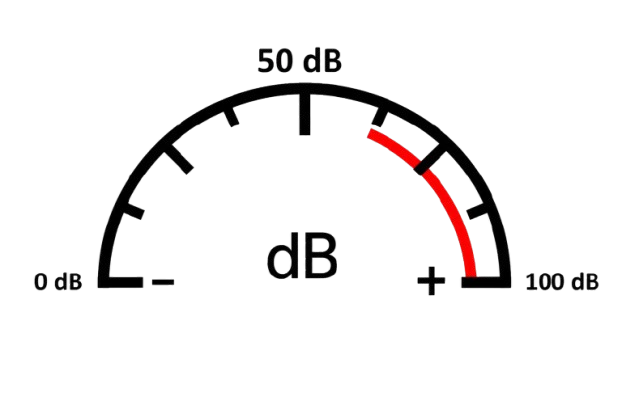
Understanding how sound is measured is critical when designing or selecting effective soundproofing and noise control solutions. Key acoustic concepts such as Sound Pressure, Decibels (dB), Sound Transmission Class (STC), and Impact Insulation Class (IIC) are used with specific purpose – to measure how sound transmission is filtered across different platforms such as walls, floors, ceilings, and building assemblies. Sound pressure levels define sound intensity, while STC and IIC ratings evaluate how the airborne and impact noise performance is reduced by assembly and transmission type. These metrics are often misunderstood or conflated, leading to diminished potential results. This guide explains how sound measurement works, helping contractors, architects, and facility managers accurately compare soundproofing systems.
Triple leaf effect
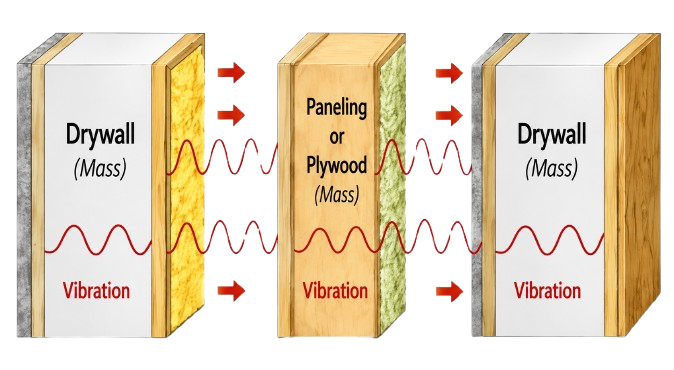
As the physical vibration causes drywall to shift back and forth – the air space inside the internal cavity oscillates as well, with compressed and decompressed space (vibrational effect). This causes the sound inside the cavity to react and move faster, forcing pressure and movement on to the center leaf surface. When this is happening on both sides of the center surface area, the center leaf is forced to vibrate at a greater amplitude than the surrounding walls – causing resonant amplification, and a spike in vibration transference reaching back out to the exterior walls with cyclical growth in volume.
Glossary of terms
ABSORPTION: A property of materials that allows a reduction in the amount of sound energy reflected. The introduction of an absorbent material into the surfaces of a room will reduce the sound pressure level in that room by not reflecting all of the sound energy striking the room’s surfaces. The effect of absorption merely reduces the resultant sound level in the room produced by energy that has already entered the room.
ABSORPTION COEFFICIENT: A measure of the sound-absorbing ability of a surface. It is defined as the fraction of incident sound energy absorbed or otherwise not reflected by a surface. Unless otherwise specified, a diffuse sound field is assumed. The values of the sound-absorption coefficient usually range from 0.01 for marble slate to almost 1.0 for long absorbing wedges often used in anechoic rooms.
ABSORPTION: A property of materials that allows a reduction in the amount of sound energy reflected. The introduction of an absorbent material into the surfaces of a room will reduce the sound pressure level in that room by not reflecting all of the sound energy striking the room’s surfaces. The effect of absorption merely reduces the resultant sound level in the room produced by energy that has already entered the room.
ABSORPTION COEFFICIENT: A measure of the sound-absorbing ability of a surface. It is defined as the fraction of incident sound energy absorbed or otherwise not reflected by a surface. Unless otherwise specified, a diffuse sound field is assumed. The values of the sound-absorption coefficient usually range from 0.01 for marble slate to almost 1.0 for long absorbing wedges often used in anechoic rooms.